How Neglected Carbon Buildup Leads to Expensive Car Repairs
Carbon buildup occurs as a natural by product of engine combustion. However, excessive carbon buildup can affect engine performance and reliability. This buildup forms on critical components such as the turbocharger, EGR valve, fuel injectors, intake valves, pistons, and exhaust system. As a result, it restricts airflow and increases engine temperatures. Eventually, neglected carbon buildup can lead to expensive vehicle repairs.
5 Expensive Car Repairs due to Carbon Buildup
Neglected carbon buildup can eventually lead to the following types of car repairs. Let’s discuss further.
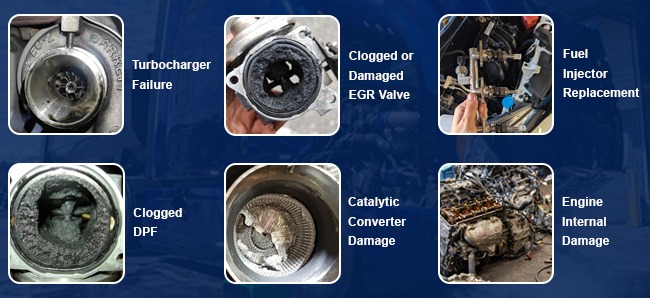
Turbocharger Failure
Turbochargers rely on a steady flow of exhaust gases to spin the turbine and generate boost pressure. Excessive carbon deposits can restrict exhaust flow, preventing the turbo from operating efficiently. It further traps exhaust gases, creating excessive heat and pressure within the turbocharger housing. The increase in temperatures accelerates wear on bearings, seals, and turbine components. Eventually, the turbo may overwork to compensate for reduced airflow, leading to premature failure.
Carbon-related turbocharger issues usually develop gradually. The initial symptoms include a noticeable loss of engine responsiveness, especially during acceleration. You may notice a whistling or whining noise from the turbo, indicating possible worn bearings or airflow restrictions. Reduced boost pressure may cause sluggish acceleration and poor towing performance. Further, black exhaust smoke may indicate incomplete combustion due to insufficient air supply. Ignoring these signs may lead to turbocharger failure.
Turbochargers are usually expensive, and their installation involves significant labour. Therefore, a failed turbocharger will lead to an expensive replacement. Further, depending on the vehicle type, additional expenses in such scenarios may involve cleaning oil lines, intercoolers, and intake components to prevent contamination of the new turbo. Therefore, it is better to perform professional carbon cleaning to maintain proper exhaust flow, reduce operating temperatures, and extend the turbocharger’s lifespan.
Clogged or Damaged EGR Valve
The Exhaust Gas Recirculation (EGR) valve helps recirculate a portion of exhaust gases back into the engine to reduce harmful nitrogen oxides (NOx) emissions. As EGR valves constantly deal with soot-filled exhaust gases, they are susceptible to carbon buildup. Over time, buildup around the valve and passages restricts movement and prevents the valve from opening or closing properly. It leads to inconsistent exhaust gas recirculation, disrupts combustion temperatures, and reduces the engine’s ability to meet emissions standards. A clogged EGR valve can cause rough idling, reduced engine performance, and poor fuel economy. In some cases, improper exhaust gas recirculation raises combustion temperatures, increasing NOx emissions and causing engine knocking or pinging.
When carbon deposits harden or damage the valve mechanism, replacement becomes necessary. Ignoring such a condition can place additional stress on the turbocharger and DPF, potentially leading to multiple expensive repairs. Therefore, regular maintenance is crucial to maintain proper EGR operation.
Fuel Injector Replacement
Fuel injectors are responsible for delivering an exact amount of fuel into the combustion chamber. Carbon deposits around injector tips affect the injector’s spray pattern. It further reduces fuel atomization and prevents efficient combustion. As a result, dirty injectors may spray unevenly or leak fuel, causing inconsistent combustion across engine cylinders. Poor fuel distribution reduces engine efficiency while increasing soot production. It further accelerates carbon buildup. You may notice symptoms like hard starting, rough idling, engine misfires, and noticeable power loss. Drivers may also experience increased fuel consumption because the engine needs to inject more fuel to compensate for inefficient combustion. In severe cases, poor injector performance may trigger diagnostic trouble codes and turn on the check engine light.
Replacing faulty fuel injectors is expensive. Further, many engines require injector coding or calibration after installation to ensure proper operation. Therefore, regular professional fuel system cleaning can help maintain proper injector performance, reduce carbon buildup, and extend injector lifespan.
Diesel Particulate Filter (DPF) or Catalytic Converter Damage
The DPF and catalytic converter are critical emission-control devices. However, their functions are different. The DPF traps soot and ash from diesel exhaust. On the other hand, a catalytic converter uses precious metals to trigger chemical reactions to convert harmful exhaust gases into harmless ones. Both depend on unrestricted exhaust flow to function effectively. Excessive carbon buildup increases soot production, causing the DPF to clog faster than normal. Regeneration cycles may not clean the soot buildup. Restricted exhaust flow can create additional backpressure within the engine, reducing engine performance. Over time, it can damage both the DPF and the catalytic converter. Symptoms include warning lights on, reduced engine power, sluggish acceleration, and higher fuel consumption.
Replacing a clogged DPF or catalytic converter can be expensive. However, regular maintenance can help maintain proper exhaust flow, improve regeneration efficiency, and reduce the risk of premature DPF or catalytic converter failure. If the DPF or catalytic converter is damaged, you will have to replace it.
Engine Internal Damage
Over time, carbon buildup may occur inside the combustion chamber, on pistons, cylinder heads, and intake valves. It reduces combustion chamber volume, effectively increasing compression ratios and creating hot spots that ignite the air-fuel mixture prematurely. Uncontrolled combustion can place tremendous stress on internal engine components while increasing operating temperatures. If ignored, the resulting heat and pressure can damage pistons, wear piston rings, burn exhaust valves, and score cylinder walls. Further, it can weaken the head gasket, eventually leading to coolant leaks and severe engine overheating. These issues often develop gradually but can quickly escalate into catastrophic engine damage if ignored.
Internal engine repairs involve extensive disassembly, inspection, and replacement of damaged components. Replacement of pistons, rings, valves, bearings, and gaskets may add considerable parts costs. In severe cases, rebuilding the engine may not be economically practical, making complete engine replacement the only viable option. However, routine carbon cleaning and preventive maintenance can help preserve combustion efficiency, reduce internal deposits, and prevent expensive major engine repairs.
Regular preventive maintenance and carbon cleaning can help prevent these costly repairs. At Edmonton DPF Service, we provide on-vehicle DPF cleaning. You can hire our experienced and skilled technicians for regular preventive maintenance of the DPF and other crucial components of your diesel vehicle’s exhaust system.